Showing posts with label village. Show all posts

Thursday, February 21, 2013

Vietnam: Cu Chi Tunnels

I had every intention of prefacing this with a warning for the sensitive or veteran reader of this blog, but, looking back on my photos, I'm no longer convinced that this post need it.  Seeing everything at the Cu Chi Tunnels themselves was so much more intense in person, the jungle baring down on me with every step I took between the trees.  Seeing various sections of the forest barbed-wired off (because there are still bombs hidden in the ares behind them, and seeing death traps everywhere, was incredibly overwhelming.  I ended up having to break off from the group and our North Vietnamese guide who seemed to take pleasure in what he was showing us.

Having seen all those things; having pictured soldiers on both sides stumbling into traps laid by the others; having realized that the Vietnamese people still struggle with the aftermath of it all, still lose civilians from leftover traps and bombs; I cannot help but feel that nothing, absolutely nothing, is worth embarking on any path that could eventually lead to that.  No word spoken out of anger, no pride-driven act of stubbornness can be justified.  I'll even go so far as to say that, in the balance of it all, I cannot even allow for an act of self-defense.

This isn't my natural inclination.  I am incredibly vindictive by nature, wanting to respond with extreme force in the face of events I feel are wrong, but thinking back on Vietnam quells those instincts.  I hated every moment of this part of the trip, but I would highly recommend it to anyone who visits Vietnam.

The Viet Cong traversed via underground tunnels, equipped with many camouflaged holes that allowed them to catch  American forces unaware.  The Viet Cong employed many children for this task.  Contrary to popular belief, it is not likely that the children were pressed into service; the Viet Cong movement was even begun by a young girl who lost he father in the extensive bombing campaign of the area.

Tourists can go inside some of the tunnels these days, but, in order to account for the distinct difference in body size between today's tourist and that of the Vietnamese people in the 1960's, a large area around the opening has been opened.  I walked the tunnels for about 30 meters, but that was more than enough for me.  In order to fit, I had to walk bent at the waist and squatting a little in pitch darkness; it was incredibly uncomfortable, and I don't envy anyone who had to live like that.

This was the most shocking of the traps I saw, probably because I wasn't expecting it.  The idea was that someone would step on the camouflaged cover and fall through onto the spikes; the cover would continue to spin, hitting the person and pushing him further onto the spikes.

This is one of many traps that were made by individual families to protect their homes.  Each family had its own, distinct style.

In seeing these things, I had a hard time not labeling the residents of Cu Chi as monsters, noting that the traps seemed designed to cause the most pain possible, going beyond self-protection.  It seemed so extreme, so unnecessary, so blood-thirsty.  But then I remembered all the bombing campaigns and, worse, Agent Orange.  (I can hardly think of a more horrific weapon than Agent Orange.)

I know it's hard to see from this picture, but this is the residual crater from a B52 bomb, left some 50 years after it was first created.  That means that erosion and plant-growth have filled in the hole somewhat.  Even still, it's so steep and deep that it requires stairs to get up from the bottom.  Don't be mistaken, both sides that fought this war used extreme measures to do so.

Spike-traps hidden under ground certainly were gruesome weapons employed by the Viet Cong, but they had other options as well.  Many of the bombs dropped on the area never exploded, and they used that to their advantage.  By collecting and cutting them open, the Veit Cong could salvage the gunpowder from inside them, creating bombs of their own.  This was a very dangerous tactic, but that did not stop it from being effective.

Replicas of the Viet Cong cutting open bombs have been moved into an opened underground bunker so tourists can have an idea of what it was like for them to have to live and work underground.  Still, this is not a fully accurate representation, as the ceiling has been removed and heightened so tourists an have a more comfortable experience.  Furthermore, the bombs would not have been opened inside the bunker; the task was far to dangerous for that.  Bombs were sawed in half outside, a two person job in which one person would saw while the other constantly poured water on the bomb to keep it from become too hot and producing sparks.  The salvaged powder was then moved inside, where new bombs were made.

The homemade bombs were clearly effective.  After several lengthy bombing campaigns, American soldiers were able to move through the Cu Chi area on foot and in tanks, unaware of the resistance measures the locals had taken.  As a result, they were caught entirely off-guard by the attacks that came.  The results can be seen above.  The Viet Cong destroyed this tank with a well-placed bomb, created from other explosives designed to allow the tank through the jungle.  In a way, it's poetic, until you stop to think about the reality of the situation. 

Bombs were not the only thing salvaged by the Viet Cong.  Any tanks that were destroyed got picked clean, as you can see from the photo above.  One of the most important assets gained from tanks was rubber.  This rubber went to making shoes for the resistance fighters.

Pictured here are several tank-rubber shoes in varying sizes.  These are the normal, every day shoes, but when there was mud on the ground, they would switch their shoes to a type that was created to leave backward footprints in the mud.  This way, the Viet Cong could leave false trails throughout the jungle, often leading American soldiers into traps.

It's incredibly easy to want to vilify people surrounding the war.  People vilify the Americans (I've never heard the Australians get vilified, but that doesn't mean it doesn't happen.), the North Vietnamese, or those who didn't get involved.  But I'd like to propose that pointing fingers is entirely useless, and somewhat misses the true lesson that we should take from this.  I cannot clearly define a "good guy" and a "bad guy" in this war, nor can I clearly define a "winner" and a "loser", what with all the PTSD amongst American and Australian soldiers and unexploded bombs and mines across Vietnam that still regularly kill children.  The words of James Cameron came constantly to me in Cu Chi, echoing through my mind as I tried to process what I was seeing: "This is sad, very sad, only."  There is nothing that will ever happen that can justify this.  I'm sure my saying that will upset some people, and you are all entitled to your own opinion, but I beg you to think of everything that happened in Vietnam.  Research it, sear it into your mind, and use what you find to help you weigh your future decisions.

Wednesday, February 6, 2013

The Korea of Yesterday

While being here in Korea, I'm often confronted by people and stories of their time in Korea. Frequently, I'm told, "I went back, and I couldn't recognize it anymore." I know the mere facts, having only come here for the first time in 2011, but I've found their stories believable. I mean, why not? Look at the facts with me:


  • In 1950, the Korean War started.  What could be called an extension of the Cold War, it could be very callously summed up as a fight for and against communism.  As it seems to be with any country that is honestly entertaining communism, Korea was not yet a major player in the global theater.
  • Until the end of the Korean War, people lived in a survival cycle: survival cuisine, survival housing, survival clothing... it looked roughly like this:

  • I took this picture on my first cultural trip in Korea
    (외암리민속아을 - Oeam-ri Folk Village).  It's a low-class home in
    what is now called a "traditional village," a working village
    that's been kept in the traditional style due somewhat to the desire
    for the preservation of Korea's history, but mostly because
    tradition dictates that the oldest son of a family is
    to take over and care for the family's estate for a certain
    number of years after his parents pass.
    • After the Korean war, Korea BOOMED; it's growth was unprecedented.  It went from looking like the photo above to looking like this in a matter of 50 years (less in some places):
      This is a pretty typical sight in Korea these days: Rows of apartments
      that all look the same and clearly went up quickly.  Assume each floor
      holds two family-sized apartments, and that will give you a
      decent idea of the population of Korea.
    • Because of the fast growth spurt, there's a lot of aspects of Korean culture that haven't caught up with modernity.  For example, many building projects are still undergone in the quickest way possible, rather than the most lasting.  Korean cuisine is still very much based on survival foods, rather than based on an expanding palate.  However, consumerism is at an all-time high, so the things that are in and around those housing units and food products are cutting edge (and expensive).  It's an interesting quirk of Korea.

    So, there you have it, based on the growth and history of Korea, I could easily believe that very recently everything was different in Korea.

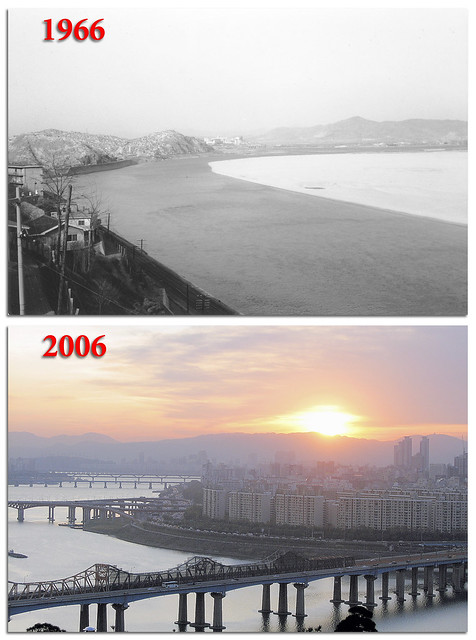
    What I wasn't prepared for was a recent flickr stream of one expat's view of Korea from 1958-1966.  It's crazy, isn't it?


    Some things have changed:


    Some things haven't:
    Lake Cheongpyeong Farms 1960
       
    Oeam-ri Folk village 2011.  I know, it's not the exact same
    place, but I'm pretty sure it's the same mountain.


    So, that is your Korea culture/history lesson for today.  Tune in next time for more exciting adventures! 

    (All picture from Korea in the 1950's and 1960's on this blog post are taken from Somthers52's Flikr steam.)

    Wednesday, July 18, 2012

    Tuesday, January 10, 2012

    The one I've been really excited about posting, but kept putting off because I've knew it would take at least an hour to write... AKA: my family's trip to the DMZ.

    (Believe it or not, I've had no caffeine today... mostly because I had three coffee dates with three different groups of people two days ago, and, well, I can still feel the affects... especially when I watch videos about caffeination.)

    Okay.  I really am excited about this.  I've been secretly working on this post since 2011 (Dec. 31).  The short story is that on December 31, instead of getting drunk and making things explode, like the rest of the world, my family decided (well, I decided, and my family decided not to rock the boat) to go visit the front lines of a war (The Korean Demilitarized Zone) that's been waging for the past 70 years.  Yup.  70.  That's the very cold, calus version of what happened.  Here's how it happened in my head/heart:

    We spent the night in Seoul, sot that we wouldn't have to get up even more insanely early to get to the USO in time.  As it was, I was incredibly stressed, trying to make sure we got there before they started turning people away.  I think I upset my family, but I hope they understood why I was so stressed.  They joked later about it, and how they were calm, because they couldn't understand the cabbie saying he had no idea where he was going, whereas I did... so I think they are chill about it now.
    I felt a little awkward taking this picture, as I did about all the pictures we took while smiling on this trip, but I was so happy to be sharing this experience with my family, and I realized that the last family photo we got was in... maybe '09???... so I knew we needed some more... preferably with us looking happy to be around each other.
    In between many successive games of Catan and our briefing from the military, I got picture number one of my whole family.  We were all tired, but I think it turned out pretty well.

    The military personelle encouraged us to take many pictures and videos during the briefing, but asked us to turn off our flashes, as they had to memorize their spiel verbatim.  The way they talked about it, it sounded like they were trying to tell us that there was a lot more to the story than what they were allowed to tell us (duh).  I couldn't help but note that I never heard a cause for this war, and I never heard a cause to most of the fighting incidents between North and South Korea.  This is where my agitation began in the trip.  It grew throughout the day - a continual frustration at a war separating families and friends, all over what seems to be the selfish desires of some political leaders.  Why must our governments think only of themselves and rarely represent the people?

    I'm including this photo, as we were never allowed to photograph Taesongdong (or anything on the South side of the DMZ, really), because it is such an important part of the DMZ.  Both North and South Korea are allowed a village within the DMZ, but the purposes of these villages are as vastly different as the political strategies of each side.  The people whose lineages are from Taesongdong are allowed to maintain a residence within the village.  There is a strict 10pm curfew, and residents must spend somewhere in the order of 340 nights a year within the village (students are granted an exception).  Failure to comply results in the immediate removal of your nuclear family.  Women may marry into the village, but men may not.  Students are given full scholarships to attend any university in Korea (this is a HUGE deal).  This is a major show of faith on the part of South Korea.
    (I will write about the North Korean village in a little bit.)

    Our guide/guard, Pfc. Futch, was both informative and entertaining, exactly the right combination to keep me from getting to introverted on this trip, and leaving feeling entirely frustrated/depressed.  He expressed an interested in attempting to transfer to Germany, so I spent some time talking with him about what to expect there.  It was nice to find someone else excited about that place.  I think the best part, though, was that he kept us feeling safe the whole time we were there, despite the fact that we were staring down a member of the Korean People's Army (North Korea) the whole time.
    We were so close to North Korea... it sends little shivers down my spine, thinking about it.  Would this man kill me, given the chance?  Most likely.  I'm having trouble finding words to express the sadness-thrill-fear mix that is engulfing my stomach right now.  So I will here reiterate my constant desire for the world to see that peace cannot come from violence.  And I will voice for you your "broken world" counterargument, and we can all move forward.
    Republic of Korea (ROK) (South Korea) soldiers face off with a KPA soldier in their modified taekwando stance and dark aviator sunglasses, designed specifically to prevent their showing any emotion toward their North Korean counterparts.
    While observing this, I couldn't help but reflect back on my many Civil War class lessons, and the discussion of brother-on-brother fighting.  How many families are forced to fight and kill each other because of this war?  How many lives are ripped apart?  How could this possibly be worth it?

    Momma, me, and Daddy in at the Joint Security Area (JSA), yards from the North Korean line.

    This table marks the North Korean line, within a South-Korean-controlled building (so it's still technically South Korean).  I (and a lot of other people) did, however, get a bit excited about crossing the line "into" North Korea.

    These posts mark the line over which we CANNOT stray.  Don't be fooled, it's heavily guarded by posts and checkpoints along the way.

    Kijongdong, the North Korean village within the DMZ, more commonly referred to as  Propoganda Village.  Atop the 525-foot Tower flies a Democratic People's Republic of Korea flag, weighing in right around 600 pounds.  This flag is so heavy that it must be lowered in storms, or else it will tear under its own weight.
    The major difference between Kijongdong and Taesongdong are the requirements to live within the villages.  While Taesongdong is rather strict, the rules to live in Kijongdong are rather simple, surprisingly enough.  From what I can tell, here is the one rule: DON'T.  After several defection incidents, North Korean citizens are no longer allowed this far south in their country.
    So why the village at all?  Well, that answer lies within it nickname.  For many years, vast amounts of propaganda about the wonder of North Korea blared, deafeningly loud, from a speaker in Kijongdong, eight to ten hours a day, encouraging their neighbors in Taesongdong to defect to the "wonderfully prosperous village."  Those who did would be unknowingly met with a sickening surprise: The village is nothing but an expensive, vast Hollywood set.  The buildings are hollow, with painted on doors and windows.  A few buildings have actual holes for windows, so the South Koreans could see lights within them.  This plan is actually what proved their lack of floors, as the light is very bright at the top of the building and gradually gets more dim on the way down.  No, the only thing that would be there to welcome these defectors are KPA military, no doubt to interrogate and kill them, on accusations of espionage.  (Call me biased, but I dare you to prove me wrong.)

    This is a memorial, marking the spot where Captain Arthur Bonifas (for whom the U.S. military base is named) and one of his men were brutally axed to death by KPA soldiers.  The event, known as the Axe-Murder Incident, revolved around the removal of a tree that had grown so tall as to block off some rather crucial sight-lines between two check points, one of which included a bridge between North and South Korea.  This apparently seemed like a crucial piece of strategy to the KPA soldiers, as they attacked in a swarm to prevent its removal.

    This is the aforementioned bridge, also known a The Bridge of No Return.  There was a decent-sized POW exchange here, in which the POWs were told to pick a side, but, after they did, they would never again be allowed to cross the line.  I can't help but break for those people.  Again, there are so many families broken in half by this line.  How do you chose which part of your family to never see again?

    Between this picture and the last, my dad and I opted to join the group touring the "3rd Tunnel."  A series of tunnels were found, leading from North Korea, under the DMZ, and surfacing, each about an hour away from Seoul.  We went all the way down to the North Korean line, where we could peer through a window, cut in on of the three walls now blocking the two sides.  In case that's not enough to stop someone, there's also a considerable amount of razor wire, and I'm pretty sure there are explosives.
    There are four tunnels reported to be found, and about sixteen that are reported to be unfound, but I have a hard time believing that they still unknowns.  Maybe I have too much faith in our military, but I'm willing to bet that they were all found within a month or two of the first one.  Whether or not the military wants to report that is on them, but I know I wouldn't.  That's just bad strategy.

    The photo above was taken at Dorasan Station, the last operating South Korean station before North Korea.  There used to be another one, further North, but the DPRK abused it, and so it was shut down.  I can't help but be excited about this station.  One day, when Korea is unified again (and I firmly believe it will be), this station will connect Busan (the Southern-most train station in Korea) to Lodon.  I fully intend on traveling the whole length of these tracks within my lifetime.

    One day, I will show this picture to my grandchildren, as so many grandparents showed us their pictures of the Berlin Wall.  I will tell them how so many people thought that the cities down these tracks were closed of forever, and I will tell my grandchildren how those people were wrong.  I will tell them how my fingers were not a "V for Victory," but a sign of peace, my hope for the future and the legacy I want to leave behind.

    Family portrait number two - at the crossroads of Korea.


    Pray for peace.  L-rd knows, this world so desperately needs it.

    Monday, October 31, 2011

    안성 구메 마을하고 칠장사 사원

    Well, I promised more cultural excitement, and here it is - the moment you've been waiting for.  I'm a little behind on my blog posts; I'm sorry... but I've been doing all sorts of cultural things, about which you want to hear... so you'll just have to put up with a little bit of a time delay. :)  (It's not like I'm in Korea or anything...)

    Last Saturday, I got the opportunity to go on a most amazing cultural trip.  It was cold and wet and sent my SID into overdrive, but I thoroughly enjoyed myself, especially the time I spent at 칠장사 사원 (Chiljangsa Temple).  At the temple, I spent a lot of time purposefully avoiding people and just soaking in my surroundings.  There's something in me that resonates with the Buddhist lifestyle, so going there was a treat for me.  I think, one day, I'd like to spend some time learning from a Buddhist monk (if I, being a woman, would be allowed).  This day was not that day, but... maybe one day...

    Okay.  Without any further ado, here are the pictures from 안성 구메 마을 (Anesong Agricultural Village):
    This trip really should be subtitled "How many ways can you use bamboo," but there's no option for that on my blog, so I'm just letting you know here.  So we started off the day by making bamboo massage sticks.  This photo is just the bamboo branches we used.  Keep on the lookout, because my massage stick will probably end up as a Christmas present for someone or something... They also make great percussion instruments and weapons.


    Speaking of weapons, we got to try our hands at the Korean-style of archery.  The main difference seems to be their grip on the arrow.  I shot one and only one arrow, and here it is... barely making contact with the target board.  (It's the crooked one.)

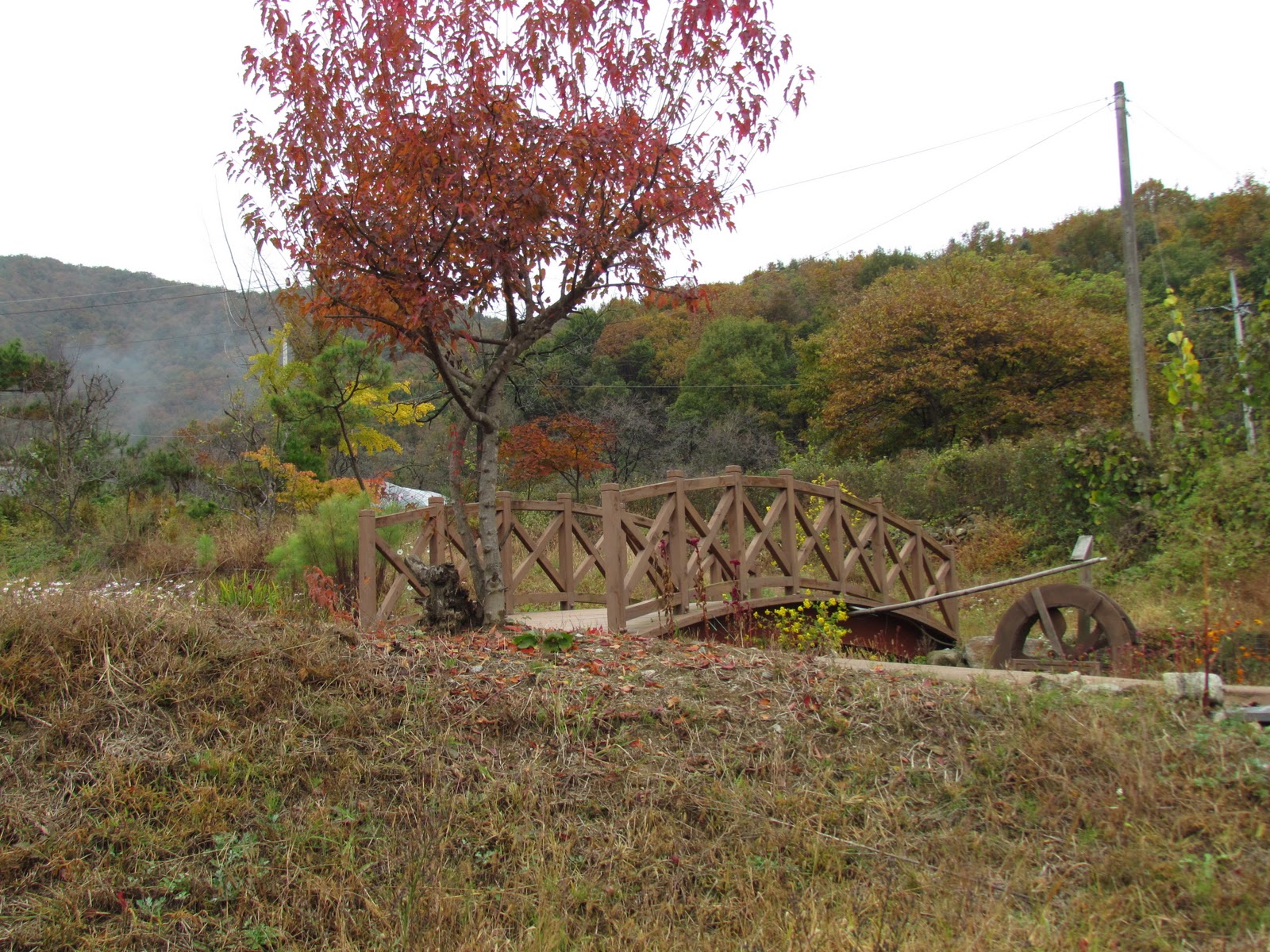
    It is now Fall in Korea, and I really haven't seen a more beautiful place for it.  You all can enjoy New England all you want, but I'm all about Korean leaves (in cultural locations) now.

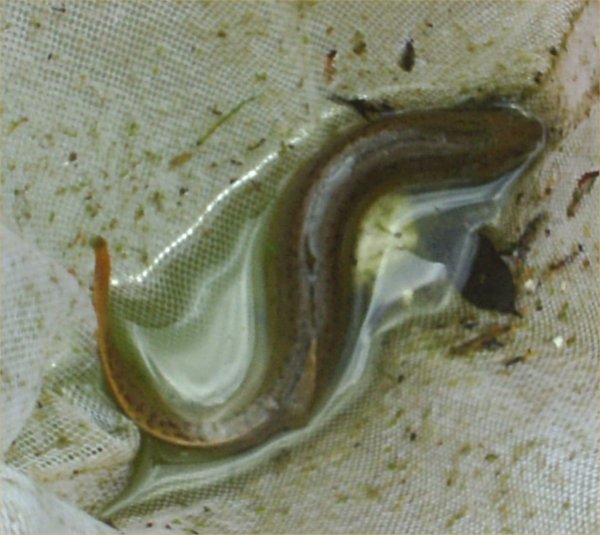
    Several people also went loach fishing.  Basically, these things look like the lovechild of a catfish and a leech.  You climb into the spider/scorpian-looking-thing infested mudhole, place your bamboo-enforced net in the water, stomp on the mud, pull your net back out, and see what you got.  Sadly, there were no waders big enough for my high-instep.  All together now: "Oh, that's too bad."  ;)

    We each tried our hands at picking persimmons with these bamboo sticks.  Personally, I think it would be much more time-effective to use your bamboo to make a ladder, but I'm not going to argue with thousands of years of tradition.  Instead, I tapped into an even older tradition: the damsel in distress.  Yes, I managed to flag down two men who were kind of enough to hook me a persimmon (and another one when I accidentally knocked down the first) and let me pull it down as if I'd done it myself.  :)

    The following are from 칠장사 사원 (Chiljangsa [Buddhist] Temple), I'm not going to caption these (if you want those, you can check out my Facebook), in the hopes that on their own they can reflect the peace and wonder (keep an eye out for the healing water) that was at the temple:


     Here's the ask the audience time:  What do you want next: a traditional Korean recipe, my personal reflections, or some more from my students?


    Love!

    Tuesday, September 6, 2011

    For Alex

    Alex asked me about playing my violin here, so today I will write about that.  (And the rest of my Sunday, I think.)

    Sooo, Sunday morning, I showed up at church at 10:30 for the chamber orchestra practice, and realized that I had left my tuner at home. (Boo.)  The only other player there was the sax.  By 10:45, two flutes had shown, and just before 11:00, the cellist showed up, started tuning, and immediately popped her A string.  She didn't have a spare, so she played on three strings.  They stuck a lead sheet in front of my face, which made me rather happy.  I was afraid I would be reading complex classical music, an intimidating thought in a land of serious classical musicians.  However, improv is something I am pretty okay with, and, as a result, I had a GREAT time.  We played a couple praise tunes I didn't recognize, but we also did Shout to the Lord and Draw Me Close to You.  We played with some of the hymns too.  I was especially thrilled to hear Joyful, Joyful, We Adore Thee, since I had done that in Suzuki and knew the harmonies, but what made my day was when they started In the Garden.  That was my lullaby growing up, and my one of my late grandfather's favorite hymns.  All-in-all, the violin experience was unprofessionally perfect.  I love playing, especially in a group where the audience can't tell if I'm out of tune (thank you, Mr. Saxophone player in a C-instrument dominated group).  :)

    After church, we went on a culture trip to a traditional Korean village (you may have seen pictures of this on my Facebook page).  What I DIDN'T tell you was that the pastor was totally trying to set me up with this Korean guy, Ricky.  The pastor made me ride in Ricky's car, and designated us as a group by ourselves... so I spent the whole day with him stuck to me like glue... ... ... it was awkward to say the least.  At dinner, Ricky poured my cup full of water and everyone else's half full, which I'm told is sort of a profession of love, and he traded seats with a couple of people so he could sit next to me.  Ohhhhhhh the stresses of trying to politely rebuff advances while avoiding starting another world war...

    Anyway, here are some photos of my trip (click on them to make them bigger):

    This is the water wheel at the entrance to the village.

    People actually live in the majority of the village.  It is the responsibility of the oldest son in Korea to move to a home near his parents' grave and live there for three years after they pass.  There is a burial ground in this village, so that is the reason why most people live there.  It's so pretty though, it's almost worth giving up all the amenities of modern life.

    These are warriors that are carved from trees and placed at the front of villages to protect the residents.

    This is me at the doors to one to one of the museum houses.

    Part of an upper class compund

    This is a lower class home (you can tell by the roof).  The middle class compounds have a combination of both styles.

    Rice fields forever - they smell really good!  I wanted to go running through them, but the bases of the stalks are totally submerged in water, so that would not have been a good plan.

    You know me and tiger lilies.  If it hadn't been for the nasty white bugs on them, I probably would have grabbed one and tried to root it, but, alas... nastiness prevailed, and they're all safely waiting for another awesome photo op like this one.


    Okay!  I love you all and will continue to take posting requests via email, Facebook, or blog comment. :)